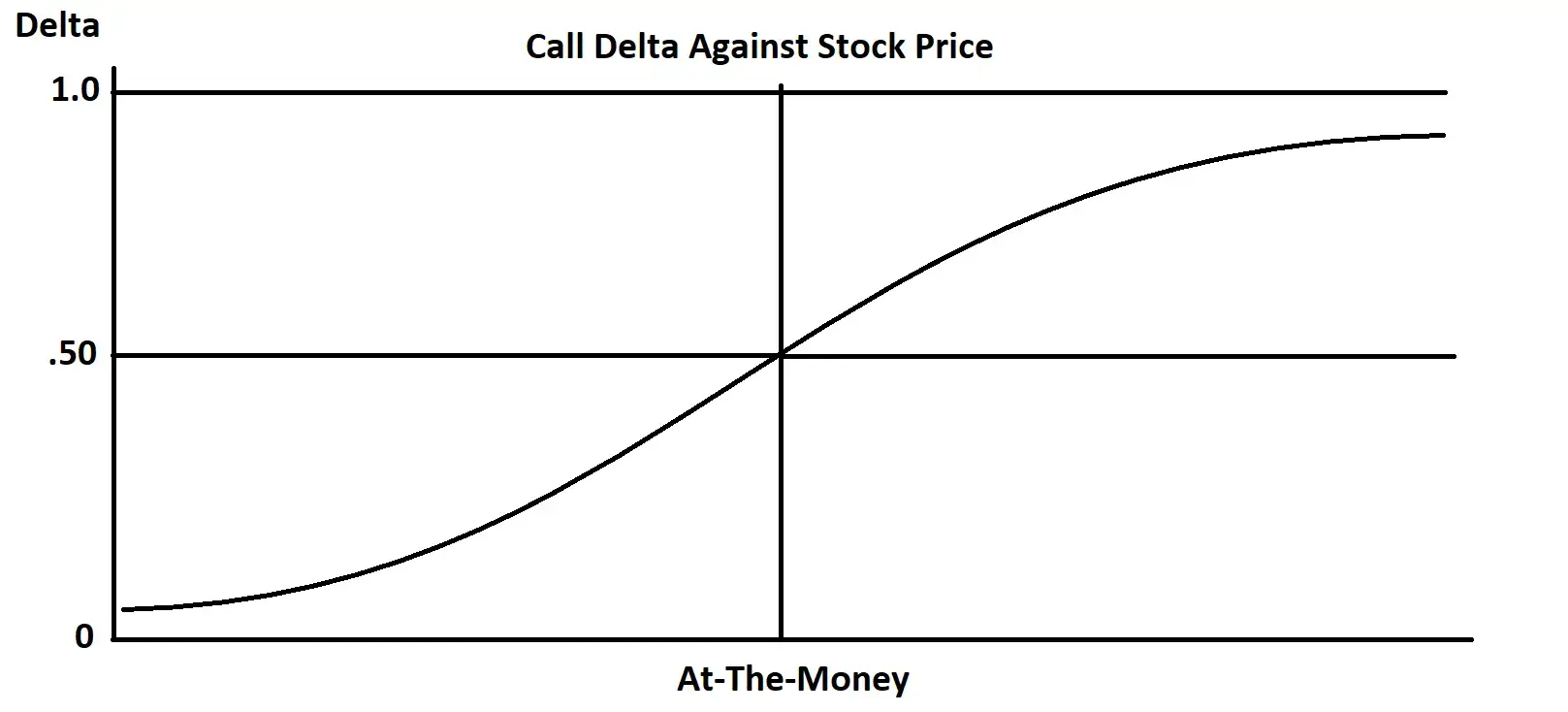
DELTA
Definition: The rate of change in the theoretical value of an option over a
one-point change in underlying price. Expressed as a percentage, it can
also be interpreted as the equivalent amount of underlying that an option
represents, or hedge ratio. Calls have positive deltas, puts have negative
deltas.
–The Delta has various interpretations:
I.
The change in the price of the option in response to the change in
the price of the underlying contract. A positive delta means that the
option’s price is positively correlated with the underlying changes
(as in the case of a call), and a negative delta means that the
option’s price is negatively correlated with the underlying changes
(as in the case of a put).
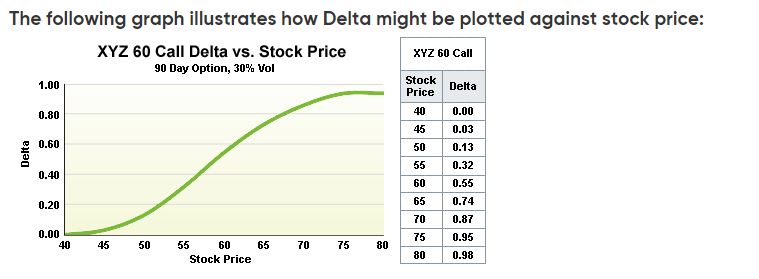
Ex: The 100 call is trading for 3.00 and has a +50 delta (with the underlying stock trading at 100) If the price of the stock goes to 101,
the call value would increase to 3.50.
II.
The equivalent amount of underlying position that the option .
represents also used as the effective hedge ratio.
III.
Ex: The 100 put has a -50 delta, which means that your exposure in the
marketplace is the equivalent of being short (negative delta) .50 or 50%
of an underlying contract (in the case of equities, since 100 shares is
considered one underlying it is equivalent to being short 50 shares.) If
you bought one of these puts and wanted to hedge that exposure, you
would need to buy 50 shares in order to delta neutralize your positions.
The probability that the option will be ITM or exercised at
expiration. (If we ignore the sign of the delta.)
Ex: The 100 call, with the stock trading at 100, would have an
approximately.50 delta-the call is exactly ATM and has a 50% chance
of going in the money.
IV.
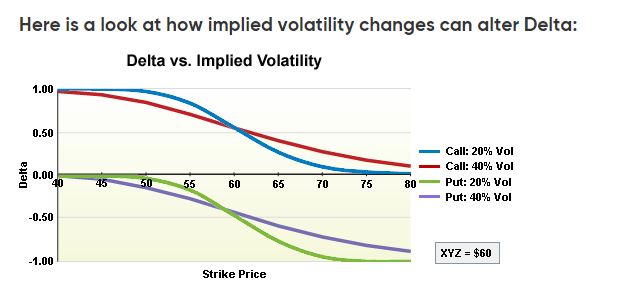
The delta of the call and the put at the same strike should add up to
approximately 1.00 (without taking into consideration the sign of
the delta-long or short).
Ex: The 100 call, with the stock trading at 100, would have an
approximately .50 delta-the call is exactly ATM and has a 50% chance
of going in the money. By the same token, the ATM put would also have
a.50 delta, or a 50% chance of ending up in the money. Together, the
two deltas add up to a 100% probability that one or the other will be ITM
at expiration.
Leave a Reply